UX research project
Existing research on AI in UX tended to fall into one of two camps: optimistic literature about AI's potential to transform design workflows, or broad adoption surveys. What was missing was a closer look at how designers themselves talk about integrating
AI — where it genuinely helps, where they push back, and why.
“How do UX designers perceive and integrate AI into their design workflows?”
Overview
AI tools are showing up everywhere in UX workflows, but most of what's written about it is either hype or speculation.
For our bachelor's thesis, my research partner Maria Amare Worku and I wanted something closer to the ground: how are practicing UX designers actually using AI today, and where do they draw the line?
We designed and ran a workshop with five UX professionals, using a method we adapted from user journey mapping but pointed at designers' own workflows instead of a user's. Participants mapped where AI showed up across the five stages of the design process, then talked through what they'd mapped as a group. We analysed the discussion using inductive thematic analysis.
The findings push back on the idea that AI is quietly taking over design work. Designers use it heavily for the unglamorous parts — transcribing, summarising, drafting — but draw a hard line around anything that requires empathy, judgment, or creative intuition. Trust, it turned out, wasn't really about how good the AI's output was. It was about whether it aligned with the designer's own values.
Research Approach
Why a workshop, not interviews
Workshop format over one-on-one interviews because AI adoption in design is still a fast- moving area. The kind of topic that benefits from group reflection, not just individual recall. Sitting designers with peers who share the same professional context tends to surface tacit knowledge that a structured interview would miss, and it's a better use of busy professionals' time than a solo survey.
The twist: workflow mapping instead of user journey mapping
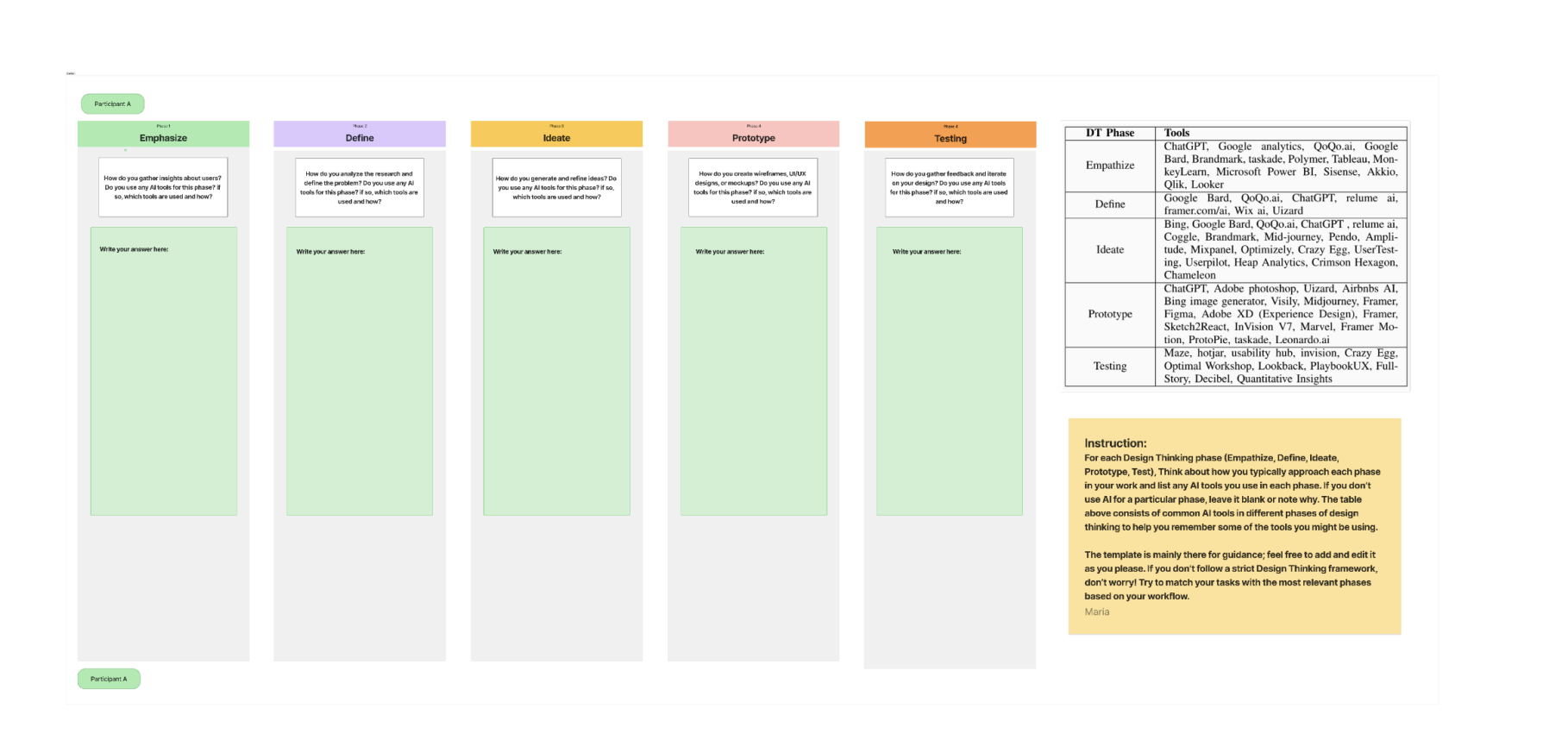
Journey mapping is normally a tool for understanding users. We borrowed the format but turned it inward — asking designers to map their own workflow across the five Design Thinking phases and note where AI tools entered the picture at each stage.
Each participant filled out their own FigJam board individually first, before any group discussion.
A deliberate choice to stop louder voices from anchoring the conversation before quieter participants had formed their own view.
Process
The session ran on Zoom with cameras on to preserve a face-to-face feel, and was piloted beforehand so we could adjust the structure before the real thing. Recordings were transcribed with Klang AI (chosen for GDPR compliance) and manually checked against the original audio for anything the transcription tool might have flattened or misread — the kind of nuance-loss AI itself was about to become the subject of.
Analysis followed Braun & Clarke's six-step thematic analysis: familiarization, initial coding, searching for themes, reviewing themes, defining and naming themes, and writing up. Coding was inductive — we let categories emerge from the data rather than sorting responses into a predefined framework
Partcipants
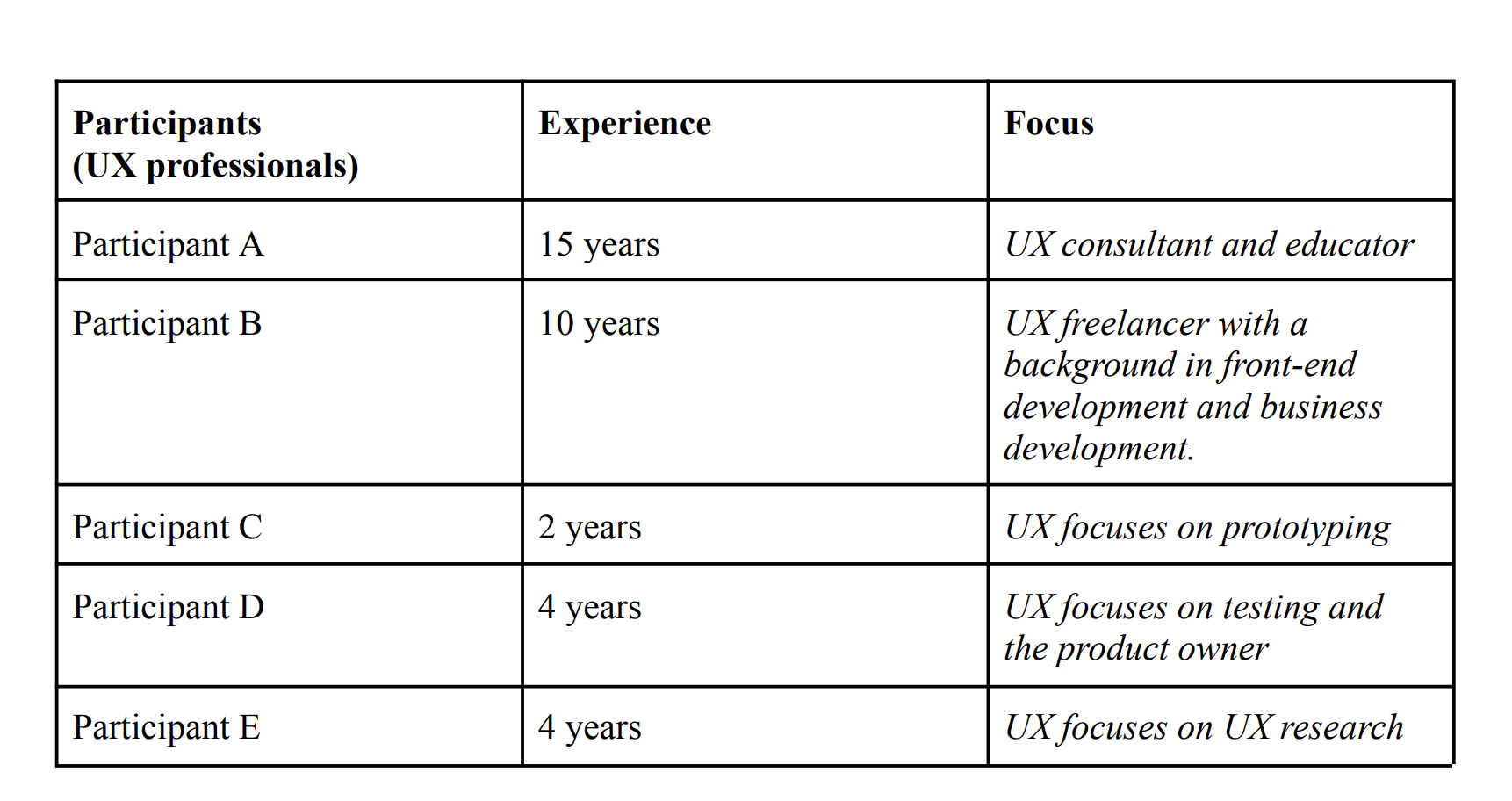
We recruited five UX professionals with a mix of purposive and snowball sampling, aiming for a spread of experience levels and specializations rather than a single profile.
Results
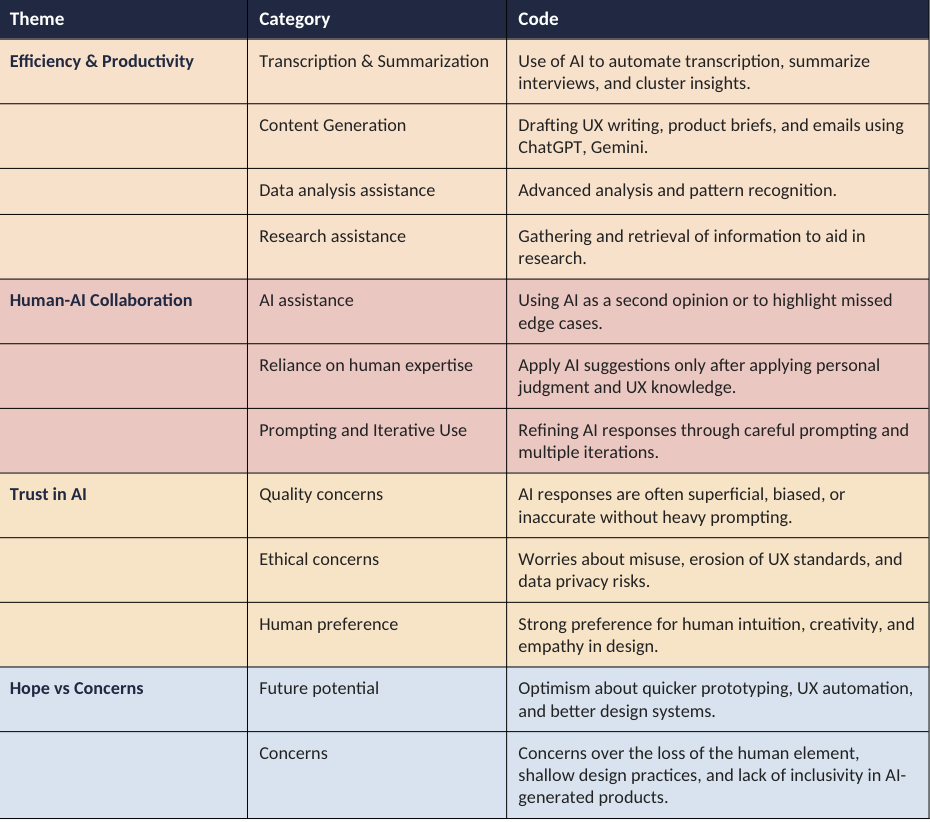
Four themes emerged from the analysis. Together, they describe a pattern of selective, guarded adoption — designers reaching for AI constantly, but still maintaining human oversight.
Efficiency & Productivity
“When I am the only one interviewing, transcription can save me time as I most often don't need to go back that often to a part of a video.”
“It needs editing, but it dramatically speeds up the writing process — I know what I want to say, but sometimes find it hard to find the right words.”
Human-AI collaboration
“Spend a lot of time giving a lot of context and information. Otherwise, the answers are very biased and very general.”
“I iterate with maybe some of the suggestions that AI had given me and the one I originally created.”
Trust in AI
“I don't trust it in terms of understanding what the user is meaning or getting this sympathy or all this knowledge of why or how or the context of what the user is doing.”
“They can do an okay product very easily, but they do not necessarily have an ethical product, an accessible product, or a good UX pattern.”
Hopes & Concerns
“We're seeing that the human part is taken away... we need to remind ourselves that AI is good with us together — we cannot take them away because then it gets, I will say, dangerous actually.”
“Better rules and laws. I will prefer it to be managed and reviewed.”
Takeaways
AI adoption in UX is real but narrow — concentrated in the Empathize, Define, and Prototype phases, and largely absent from Ideate and Test, where designers most value human judgment.
Designers assess AI output for appropriateness, not just correctness — a judgment call rooted in values and professional accountability, not accuracy alone.
For AI tools to earn more trust in design workflows, they need more transparency about how a suggestion was generated, not just better output.
Design education should be teaching critical judgment around AI, not just tool fluency — knowing when to lean on it and when to override it.
Limitations, honestly
One workshop, five participants, one hour, self-reported. This study points at trends worth investigating further rather than claiming anything definitive. A larger, more diverse sample and observational research (watching designers actually work with AI, rather than asking them to describe it) would be the natural next step.
My Reflection
This project sharpened how I think about research methodology as a design decision in itself, not just a formality — choosing workflow mapping over a straightforward interview changed the quality and honesty of what participants gave us. It also gave me a much more grounded view of where AI genuinely helps in a UX practice versus where the hype outpaces the reality, which now shapes how I evaluate AI tools in my own design work